
When an insurance carrier extends an initial settlement offer on your property damage claim, your instinct might be to accept it so you can move forward with repairs. In almost every circumstance, you should say no.
That first offer is rarely enough money to cover the actual cost to repair your home.
In fact, you should expect to reject the second or third settlement offers as well. To protect your home and your financial investment, you need to work with lawyers who know how to say no to corporate insurance tactics.
Property insurance companies are for-profit corporations. They maximize their gross revenue by selling as many premium policies as possible, and they maximize their net revenue by denying claims or underpaying them.
Despite what you see in corporate television commercials, homeowner insurance companies are not your friends or your neighbors. Their primary fiduciary duty is to their corporate shareholders and executives, not to you or your family.
When you file a claim, carriers frequently deploy field adjusters to inspect your home. However, the corporate desk adjuster who ultimately reviews the file and determines the payout will routinely offer you less than the true value of your damages. This systemic underpayment happens even when the carrier’s own field adjusters document the extensive nature of your property damage.
Insurance companies often make a low initial offer to test your patience, hoping you will accept a quick payout while leaving room to negotiate if you push back.
In other instances, carriers simply make genuine, honest mistakes. They frequently fail to realize the full scope of your damages or misinterpret what you are legally entitled to receive under the plain, unambiguous language of your property policy.

The Critical Importance of Documenting Your Florida Home Annually
To successfully dispute an undervalued settlement offer, you must provide proof of your property’s condition prior to the storm or other event that caused the damage. This is why it is essential to fully document the interior and exterior of your home on an annual basis, well before any tropical storm or hurricane threatens South Florida.
Your annual home documentation checklist must be comprehensive and include clear photographs and high-definition video of:
The entire interior and exterior structural framework of your property
All light fixtures, built-in appliances, and mechanical systems
Personal property, including high-end electronics, artwork, and clothing
Detailed views of furniture, interior flooring, countertops, and cabinets
Drone footage capturing the clean, undamaged condition of your roof and exterior siding
This documentation is vital if your policy provides replacement cost coverage for your personal property. For example, if you own a high-end couch or a complete living room set from Restoration Hardware, you are legally entitled to the replacement cost for that exact quality of premium furniture.
If you lack documentation, the insurance company will value your losses against cheap, budget alternatives from a discount furniture outlet. Without receipts, photos, and video proof, insurance carriers will systematically shortchange the true value of your assets.
Combating Pretextual Roof Claim Denials After South Florida Storms
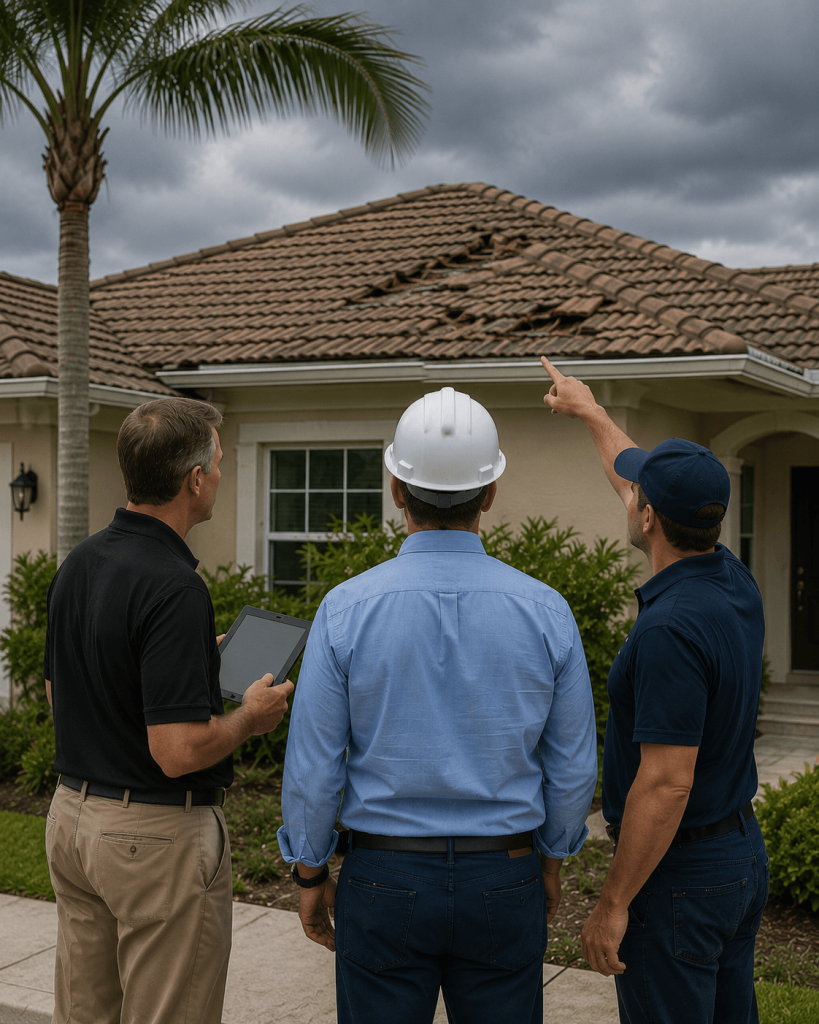
Roof damage claims are among the most heavily contested insurance disputes in South Florida. Carriers routinely deny valid windstorm or hail claims by asserting that your roof damage is actually the result of ordinary wear and tear or defective workmanship.
While property owners have a practical duty to regularly maintain their roofs to prevent catastrophic water intrusion, you should never allow an insurance company to use routine wear and tear as a pretext to deny coverage for a sudden storm event.
This pattern of corporate denial is precisely why you cannot rely on the insurance company’s assessment. When a carrier investigates your property, they bring in their own handpicked engineers, corporate general contractors, and preferred roofers who are paid to protect the insurance company’s bottom line.
To level the playing field, you must hire your own experts. Bringing in a structural engineer, a certified roofer, an estimator, or a general contractor allows you to establish an accurate, unbiased evaluation of your structural damage.
Knowing the true value of your claim gives you the leverage required to reject a low corporate offer and submit a proper, fully supported counter-offer.
Navigating Realities: Deductibles, Alternative Living Expenses, and Loss of Use
When evaluating whether to accept or reject an insurance settlement, you must factor in how deductibles and additional coverages impact your out-of-pocket recovery.
First, recognize that you will never receive 100% of your gross damage calculations because your policy deductible will always apply to the claim, and insurance carriers are under no legal obligation to waive it. Different deductibles apply to different types of losses, and these variations must be weighed carefully during negotiations.
Second, if your property is rendered uninhabitable by a covered loss, you must utilize your policy’s “loss of use” or “alternative living expenses” coverage. Under standard Florida homeowner policies, the insurance company is legally obligated to pay for temporary housing that allows your family to maintain its established standard of living.
If you are forced out of a three-bedroom, two-bath house that features a private garage, the insurance carrier cannot fulfill its legal obligation by placing your family into a basic room with two double beds at a Days Inn or a Marriott. The carrier is required to provide sufficient financial assistance to rent a temporary property that matches the size, utility, and standard of your damaged home.
You may have to aggressively negotiate with the third-party relocation vendors hired by the insurance company because carriers regularly try to minimize these payouts.

Public Adjusters vs. Attorneys: How Changes to Florida Law Impact Your Recovery
Faced with an uncooperative insurance company, property owners generally choose between handling the claim alone, hiring a public adjuster, or retaining an experienced property insurance attorney.
Insurance companies protect their corporate interests with an entire team of field adjusters, desk adjusters, corporate engineers, preferred general contractors, underwriting specialists, and supervisors. Attempting to navigate this restrictive policy language on your own leaves you at a severe disadvantage.
While you should always resolve a claim on your own if the carrier immediately offers the true value of your loss, hiring representation becomes necessary when the company refuses to treat you fairly. When deciding whom to hire, you must consider a major, highly disadvantageous change to Florida insurance law passed several years ago.
Previously, a decades-old Florida statute required property insurance companies to pay a homeowner’s reasonable attorney’s fees if the homeowner had to file a lawsuit and won a settlement or a trial in court. Under that old framework, a homeowner could hire a public adjuster, and if a lawsuit subsequently became necessary, the insurance carrier would eventually absorb the legal fees.
The Florida Legislature repealed that historical fee-shifting statute. Today, homeowners no longer possess an automatic statutory right to force an insurance company to pay their legal fees.
This change in the law dramatically impacts your financial recovery. Property insurance attorneys perform all the investigative and damage-valuation services that public adjusters provide, with the critical distinction that an attorney can file a formal lawsuit to enforce your contract.
If you hire a public adjuster and your claim is subsequently denied or underpaid, you will eventually have to file a lawsuit anyway. Because the fee-shifting statute no longer exists, you will be forced to pay a percentage of your recovery to the public adjuster and another percentage to the law firm.
This double-dilution takes substantial money out of your pocket. By hiring a dedicated law firm from the inception of your dispute, you only have to pay a single entity out of your final recovery.
The repeal of the fee-shifting law has emboldened insurance companies to systematically underpay claims by relatively small amounts, such as $500, $1,000, $5,000, or $10,000. While a few thousand dollars may seem too small for a massive corporation to worry about, underpaying tens of thousands of individual claims translates into millions of dollars in corporate savings for the carrier.
For an individual Florida homeowner, however, an unpaid $10,000 or $20,000 is a material financial blow that can halt necessary home repairs. You have paid your policy premiums faithfully, and you have a right to hold your insurer accountable.
ADVERTISEMENT. All content in this post is provided for general informational and educational purposes only and does not constitute legal advice. Viewing this post, submitting a contact form, or communicating with the firm does not create an attorney-client relationship with Wites & Rogers. Past case results, verdicts, or settlements are described for informational purposes and afford no guarantee, warranty, or prediction of a similar outcome in any future legal matter.The hiring of a lawyer is an important decision that should not be based solely upon advertisements. Before you decide, ask us to send you free written information about our qualifications and experience.Wites & Rogers is responsible for the content of this publication. Our primary bona fide office is located at 4400 North Federal Highway, Lighthouse Point, FL 33064.
Is your insurance company denying, delaying, or underpaying your claim?
Don’t let corporate adjusters shortchange your recovery. Wites & Rogers, P.A. works aggressively to protect policyholders and maximize claims. Get answers today with a Free Case Review. Remember, If We Don’t Win, You Don’t Pay Us.